RG Gemstones
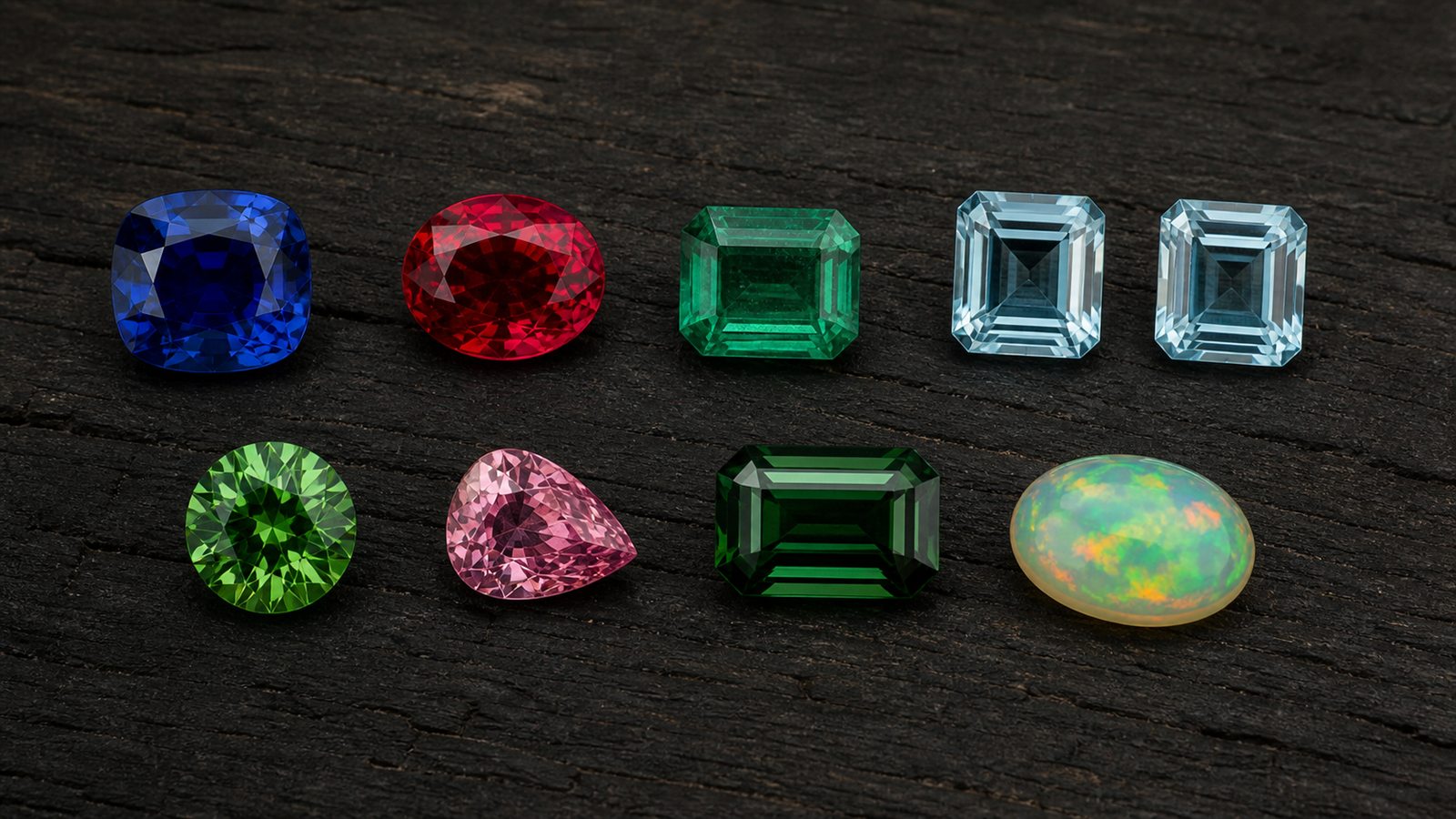
A collection of loose colored gemstones on charred wood

Gemstone encyclopedia

Gemstones by mineral species.

One consistent classification: species or mineral group first, then the colored varieties found within it.

How to read the guide

A mineral species has a defined chemistry and crystal structure. A gem variety is named for its color, optical phenomenon, or established trade use. Garnet, tourmaline, and feldspar are mineral groups containing several related species.

Mineral species

Corundum

Aluminum oxide / Mohs 9
Ruby
Red to purplish red corundum colored mainly by chromium.
Blue sapphire
Blue corundum, from pale blue to deep royal and violetish blue.
Fancy sapphire
Pink, yellow, orange, green, purple, brown, gray, or colorless sapphire.
Padparadscha
A rare pinkish orange to orangy pink sapphire variety.
Phenomenal varieties
Star ruby, star sapphire, color-change sapphire, and rare cat's-eye corundum.

Mineral species

Beryl

Beryllium aluminum silicate / Mohs 7.5-8
Emerald
Vivid green to bluish green beryl colored by chromium and/or vanadium.
Aquamarine
Light blue to greenish blue beryl colored by iron.
Morganite
Pink, peach, or violetish pink beryl colored by manganese.
Heliodor / golden beryl
Yellow, greenish yellow, or golden yellow beryl.
Goshenite
Colorless beryl.
Red beryl
Very rare saturated red to purplish red beryl.
Other beryl
Green beryl and rare deep-blue Maxixe-type beryl.

Mineral group

Garnet

Six principal species / Mohs 6.5-7.5
Pyrope
Deep red to purplish red; chrome pyrope can be vivid red.
Almandine
Dark red to brownish red; may show a star or cat's-eye.
Spessartine
Yellow-orange to vivid mandarin orange and reddish orange.
Grossular
Tsavorite and mint garnet are green; hessonite is orange-brown; hydrogrossular is translucent.
Andradite
Green demantoid, yellow topazolite, and opaque black melanite.
Uvarovite
Intense green, usually as small drusy crystals rather than faceted gems.
Mixed garnets
Rhodolite, Malaya, color-change, and other intermediate compositions.

Mineral group

Tourmaline

Related borosilicate species / Mohs 7-7.5
Rubellite
Pink, red, purplish red, or orangy red tourmaline.
Indicolite
Blue, violetish blue, or greenish blue tourmaline.
Paraiba-type
Electric blue to green copper-bearing tourmaline.
Green varieties
Verdelite ranges from yellowish to bluish green; chrome tourmaline is intense green.
Parti-colored
Two or more colors in one crystal, including pink-and-green watermelon tourmaline.
Other varieties
Colorless achroite, yellow tourmaline, brown dravite, and black schorl.

Mineral species

Quartz

Silicon dioxide / Mohs 7
Crystalline quartz
Rock crystal, amethyst, citrine, ametrine, rose quartz, smoky quartz, and prasiolite.
Included quartz
Rutilated, tourmalinated, strawberry, aventurine, and other inclusion-rich varieties.
Chatoyant quartz
Tiger's-eye, hawk's-eye, and quartz cat's-eye.
Chalcedony
Agate, onyx, sard, carnelian, chrysoprase, blue chalcedony, and chrome chalcedony.
Jasper varieties
Jasper, bloodstone, picture jasper, and many patterned opaque varieties.

Mineral group

Feldspar

Potassium and plagioclase species / Mohs 6-6.5
Moonstone
Orthoclase or related feldspar showing floating white, blue, or rainbow adularescence.
Sunstone
Feldspar with glittering aventurescence, commonly oligoclase or labradorite.
Labradorite
Gray to dark feldspar showing blue, green, yellow, or multicolor labradorescence.
Spectrolite
A strongly colored Finnish variety of labradorite.
Amazonite
Blue-green to green microcline feldspar.
Andesine
Red, orange, yellow, green, or color-change plagioclase feldspar.

Mineral species

Chrysoberyl

Beryllium aluminum oxide / Mohs 8.5
Chrysoberyl
Transparent yellow, yellow-green, green, or brown gem material.
Alexandrite
Color-change variety, typically greenish in daylight and reddish in warm light.
Cat's-eye
Chatoyant chrysoberyl; the unqualified trade name cat's-eye properly refers to this species.
Alexandrite cat's-eye
Rare material combining color change and chatoyancy.

Mineral species

Spinel

Magnesium aluminum oxide / Mohs 8
Red and pink
Vivid red, hot pink, pastel pink, and orangy or purplish pink.
Blue
Grayish blue to vivid cobalt blue; fine cobalt-colored stones are rare.
Violet and gray
Lavender, violet, purple, steely gray, and blue-gray varieties.
Other varieties
Orange, color-change, star spinel, and opaque black spinel.

Mineral species

Diamond

Carbon / Mohs 10
Colorless range
Diamonds graded from colorless through increasingly yellow or brown body color.
Fancy colors
Yellow, brown, pink, blue, green, orange, red, purple, violet, gray, and black.
Phenomenal material
Rare chameleon diamonds temporarily change between greenish and yellowish colors.

Mineral species

Topaz

Aluminum fluorosilicate / Mohs 8
Natural colors
Colorless, yellow, golden, orange, brown, pink, red, violet, and rare natural blue.
Imperial topaz
Fine orange, pinkish orange, orangy pink, or reddish topaz.
Blue topaz
Sky, Swiss, and London blue are usually produced by irradiation and heat.
Phenomenal varieties
Rare cat's-eye and star topaz.

Mineral species

Zircon

Zirconium silicate / Mohs 6-7.5
Bright colors
Colorless, blue, green, yellow, golden, orange, red, and reddish brown.
Hyacinth / jacinth
Traditional name for orange-red to reddish brown zircon.
Low zircon
Metamict material whose crystal structure has been altered by natural radiation.

Mineral species

Spodumene

Lithium aluminum silicate / Mohs 6.5-7
Kunzite
Pink to violetish purple spodumene colored by manganese.
Hiddenite
Green spodumene colored by chromium; the name is sometimes used too broadly in trade.
Triphane
Colorless, yellow, or yellow-green spodumene.

Mineral species

Zoisite

Calcium aluminum silicate / Mohs 6-7
Tanzanite
Blue to violet or purple transparent zoisite, commonly heat treated.
Thulite
Opaque to translucent pink or reddish manganese-bearing zoisite.
Anyolite
Ornamental green zoisite containing black hornblende and ruby crystals.

Mineral group

Olivine

Magnesium-iron silicate / Mohs 6.5-7
Peridot
Gem-quality olivine ranging from yellowish green to green and brownish green.
Pallasitic peridot
Rare extraterrestrial olivine crystals recovered from stony-iron meteorites.

Mineral species

Cordierite

Magnesium aluminum silicate / Mohs 7-7.5
Iolite
Blue to violet-blue gem cordierite with strong visible pleochroism.
Bloodshot iolite
Iolite containing red hematite platelets that create glittering flashes.

Pyroxene and amphibole

Jade minerals

Several distinct species / Mohs 6-7
Jadeite
White, lavender, yellow, orange, red, black, and green; vivid translucent green is called imperial jade.
Omphacite jade
Green to dark green pyroxene aggregate accepted as jade under defined gemological conditions.
Nephrite
Tough tremolite-actinolite aggregate in white, cream, green, brown, gray, or black.
Diopside
Chrome diopside is vivid green; other varieties include black star diopside and pale blue-green material.

Additional mineral species

Collector & jewelry gems

Less common transparent and ornamental species
Apatite
Blue, green, yellow, violet, pink, and cat's-eye.
Andalusite
Brown-green, yellow-green, and reddish pleochroic gems.
Kyanite
Blue, green, orange, colorless, and rare color-change material.
Scapolite
Yellow, pink, violet, colorless, and cat's-eye.
Titanite / sphene
Yellow, green, brown, and orange with very high fire.
Rare faceted gems
Benitoite, taaffeite, grandidierite, kornerupine, danburite, euclase, phenakite, and sinhalite.
Ornamental minerals
Turquoise, malachite, azurite, rhodochrosite, rhodonite, sugilite, charoite, larimar, and serpentine.

Separate classification

Non-mineral gem materials

Opal
A mineraloid: black, white, light, crystal, boulder, fire, water, matrix, and common opal.
Natural glass
Obsidian, rainbow and fire obsidian, moldavite, and other tektites.
Organic gems
Natural and cultured pearl, amber, coral, shell, jet, ivory, and tortoiseshell; modern trade is subject to wildlife laws.
Gem rocks
Lapis lazuli, unakite, and other rocks composed of more than one mineral.

Reference

Gemological classification

GIA Gem Encyclopedia

This is a comprehensive jewelry-focused list. Mineralogy also includes rare collector species not routinely cut or traded as gemstones.

Send an enquiry